Ch 6 - 7, 19

6.7

Question

Pasted image 20241018145032.png

Proof
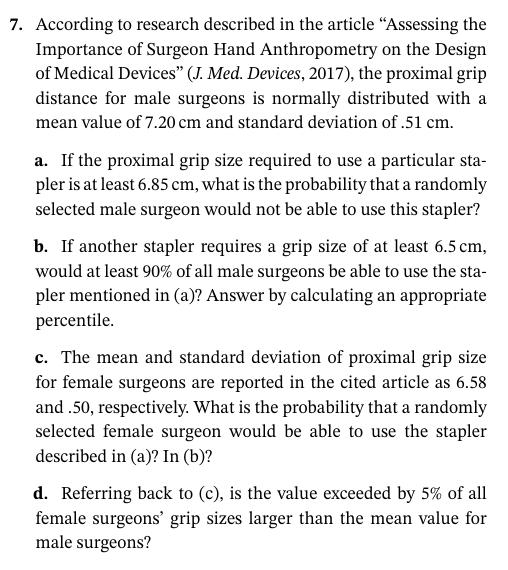
We have:

σ=.51 cm,μ=7.20 cmf(x)=1.512πexp⁡(−12⋅(x−7.2.51)2)

a.

P(X≥6.85)=∫−∞6.85f(x)dx≈.2451≈Φ(6.85−7.20.51)

b.
Check the probability:

P(X≤6.5)=∫−∞6.5f(x)dx≈.0849

So yes at least 90% of surgeons would be able to use it since 1−.0849=.9151 of all surgeons surveyed have enough grip strength.

You can also say that since ϕ(z)=.10⇔z≈−1.28 then η=μ−zσ≈7.2−(1.28)(.51)≈6.547 cm so then 90% of male surgeons have a grip strength greater than η.

c. Do a similar process:

σ=.50 cm,μ=6.58 cmf(x)=1.502πexp⁡(−12⋅(x−6.58.50)2)P(X≥6.85)=1−Φ(6.85−6.58.50)≈.2950P(X≥6.5)=1−Φ(6.5−6.58.50)≈.5636

d. We want to calculate η.95 for the female surgeons and compare to μmale=7.20 cm:

F(η)=.95→η≈7.40 cm

Thus this value exceeds the average for the male grip strength.
☐

6.19

Question

Pasted image 20241018153049.png
Pasted image 20241018153054.png

Proof
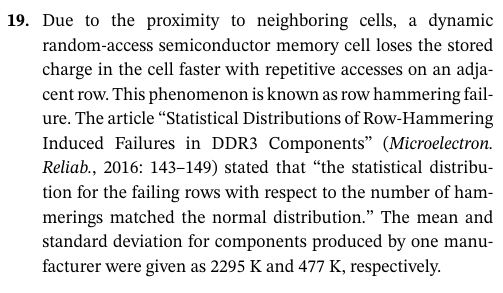
We have μ=2295K and σ=477K.

a.

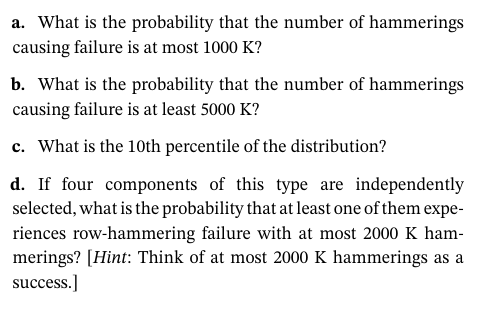
P(X≤1000)=Φ(1000−2295477)≈Φ(−2.7149)≈.0033148

b.

P(X≥5000)=1−Φ(5000−2295477)≈1−Φ(5.6709)≈1−.99999≈0

c.

Φ(z−2295477)=.10⇒z−2295477≈−1.28155⇒z≈1684 K

d.
First let's find the probability p=P(X≤2000)=Φ(2000−2295477)≈Φ(−0.6184)≈.26815585. Having this, we are asking for the probability:

P(at least one)=1−P(none)=1−(1−p)4≈.7131

We also could've used a Binomial Experiment with n=4 and p as described above, with x=0 to get P(none).
☐